BLOG
Choosing mosaic for your home: finishes and coverings
Are you undertaking the bathroom renovation?
Or are you looking for ideas for coverings in your new home? Mosaic adds a touch of style, and there are various types with more or less regular designs and patterns.
Mosaic is an art form dating back to the 3rd millennium BC. Beyond its aesthetic purpose, mosaic art always tells a story; with a bit of imagination and some modifications, it can truly find a place in many rooms. 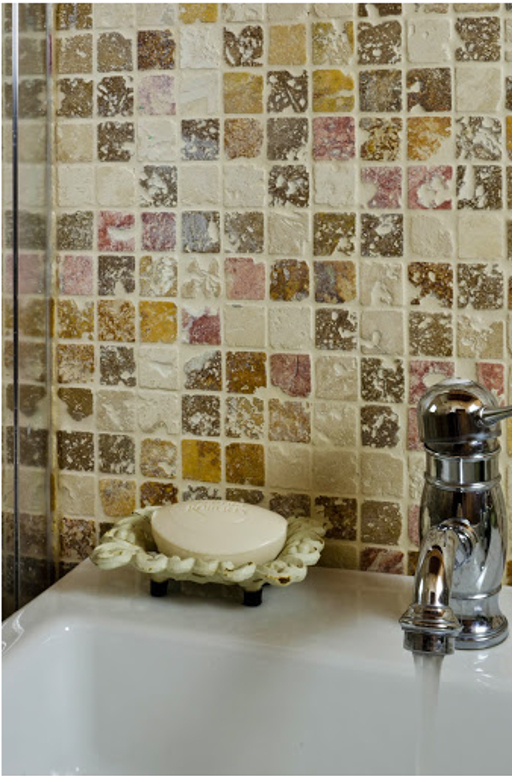
The finish indeed determines the sensation you will feel when touching the material.
- Travertine is a natural stone and therefore features characteristic holes, which are clearly visible in the Rural finish, where the material is slightly polished but the holes are left open.
- The surface is soft in the case of brushed surfaces, velvety and pleasant to the touch.
- For those who prefer a polished material and a flat surface, it is possible to fill the holes with colored cement and then polish: in this case, you obtain surfaces that are easy to maintain and elegant.
There are also mosaics with a characteristic antique finish and others where the material is visible in its three-dimensionality, the so-called split-face mosaics.
Your home with mosaic decorations
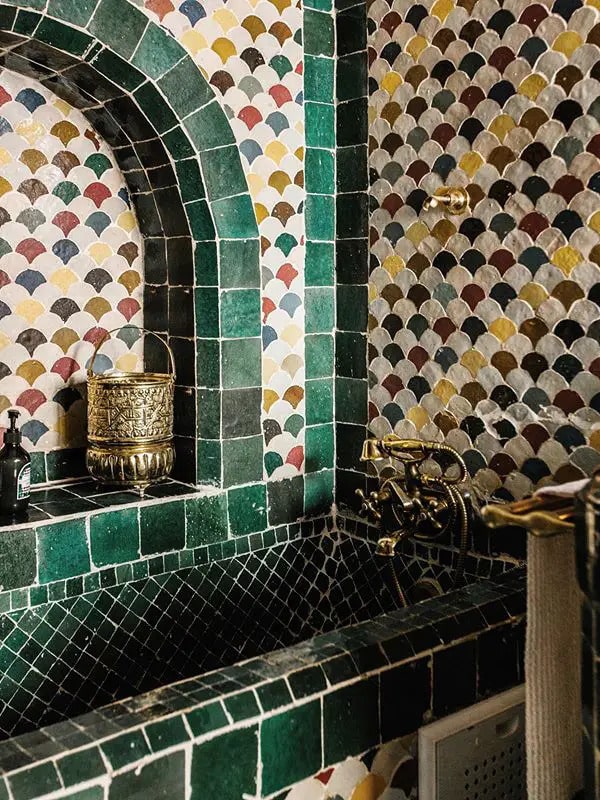
Mosaic is ideal for bathroom coverings. Whether used on all walls or to highlight a detail, it is a refined element with a strong style, but for some time now, mosaic decorations have also entered other rooms of the house: to furnish, add movement to walls, and create distinctive graphic patterns.
They are a modern decorative element perfect, for example, for the living room and to cover particular elements like the fireplace.
Mosaic can also easily enter the kitchen and can be used to cover the wall behind the work area, stove, and sink; the area where it is most commonly used is behind the kitchen counter: walls get dirty easily during food preparation, and it can therefore be used to cover this area (in English, it is called a “backsplash” to indicate the splashes produced during food preparation).
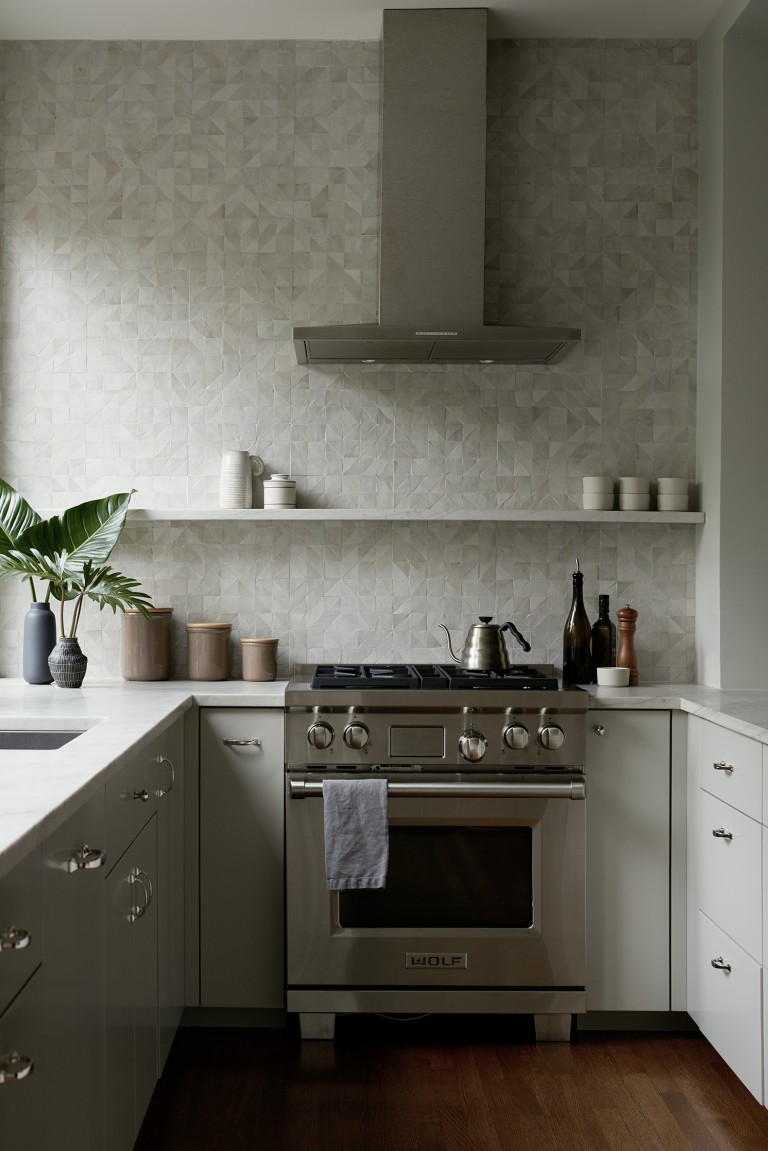
Mosaic can therefore be chosen to decorate the entire wall as in the example above when the kitchen is open and minimal with only small shelves and the hood, or just for the area under the cabinets. When choosing shape and color among the various available options, always consider the color of the furniture and, of course, the kitchen counter: in many cases, both the kitchen counter and the backsplash area are made of the same material to provide uniformity.
Travertine and natural stone can then ensure significant resistance and durability, essential characteristics for such a lived-in environment.
Photo credits: domino